Scuba Diving Hand Signals Essential Communication
Learn the universal hand signals for clear and effective communication underwater with your buddy.
Learn the universal hand signals for clear and effective communication underwater with your buddy. Mastering these signals is not just about convenience; it's a fundamental aspect of dive safety, allowing you to convey critical information, express comfort levels, and share exciting discoveries without uttering a single word. This comprehensive guide will walk you through the most common and essential hand signals, discuss their importance, and even recommend some products that can enhance your underwater communication.
Scuba Diving Hand Signals Essential Communication
Why Underwater Communication is Crucial for Divers
Imagine being 60 feet underwater, surrounded by vibrant marine life, when suddenly you feel a cramp in your leg. Or perhaps you spot a majestic manta ray gliding gracefully in the distance. How do you tell your buddy? You can't just shout. This is where scuba diving hand signals come in. They are the silent language of the underwater world, enabling divers to communicate effectively and efficiently. Without them, diving would be a much riskier and less enjoyable activity.
Effective communication ensures that you and your buddy are always on the same page. It helps prevent emergencies by allowing you to signal problems early, and it enhances the overall dive experience by letting you share observations and plan your next moves. From simple 'okay' signals to more complex emergency indicators, each hand signal plays a vital role in maintaining safety and camaraderie beneath the waves.
Basic Scuba Diving Hand Signals Every Diver Must Know
Let's dive into the most fundamental hand signals that every certified diver should have memorized. These are your bread and butter for everyday diving scenarios.
The OK Signal Confirming Well Being
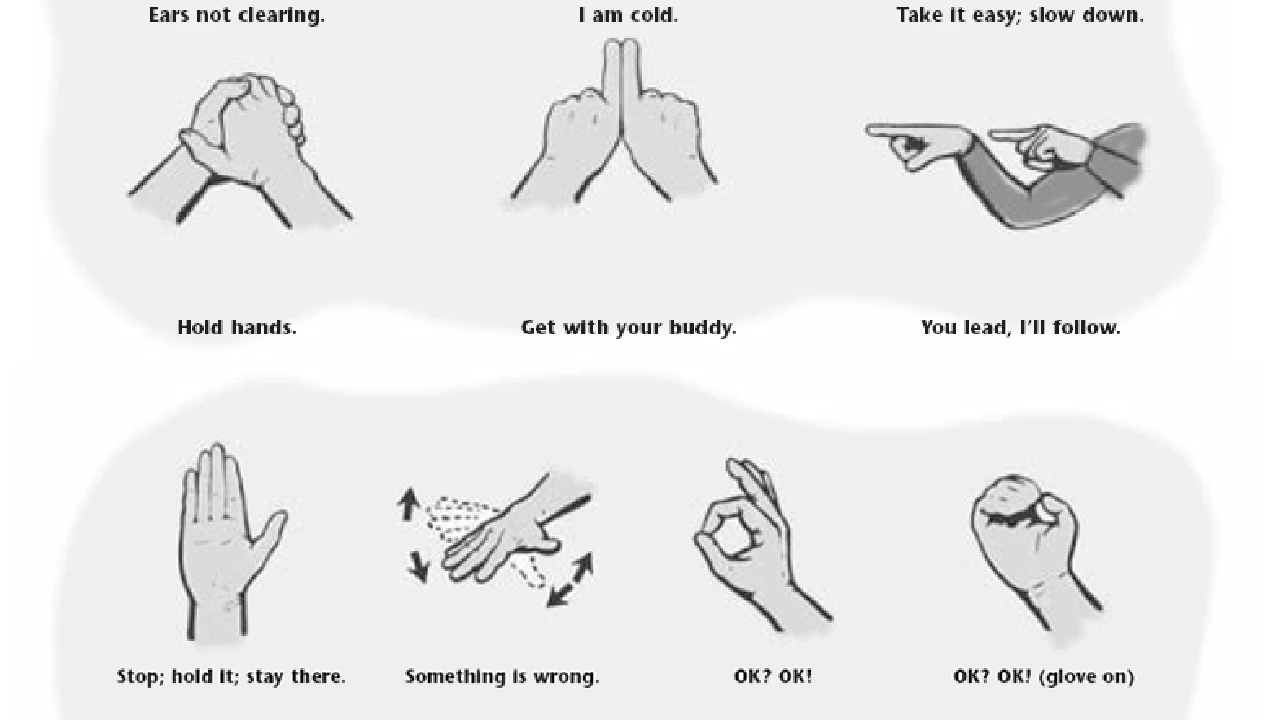
This is probably the most frequently used signal. To make the 'OK' signal, form a circle with your thumb and index finger, extending your other three fingers upwards. This indicates that everything is fine, you're feeling good, and you have no problems. Your buddy should return the signal to confirm they've received and understood it. It's crucial to give and receive this signal frequently throughout the dive, especially at the beginning, at depth, and before ascending.
Problem or Something is Wrong Signal
If you have a problem, or something feels off, extend your hand flat, palm down, and rock it from side to side. This signal immediately tells your buddy that there's an issue and they need to pay attention. It's a general signal, and once given, you'll likely follow up with a more specific signal to indicate the nature of the problem.
Go Up or End the Dive Signal
To signal that you want to ascend or end the dive, extend your thumb upwards. This is a clear indication that it's time to head towards the surface. Your buddy should acknowledge this signal before you begin your ascent.
Go Down Signal
Conversely, to signal that you want to descend, extend your thumb downwards. This is used at the start of a dive or if you need to go deeper during the dive. Always ensure your buddy acknowledges before changing depth.
Stop Signal
To signal 'stop', extend your hand flat, palm facing your buddy, similar to how you'd signal someone to stop on land. This is used when you need to halt movement, perhaps to check something, wait for your buddy, or address an issue.
Look at Me or Pay Attention Signal
To get your buddy's attention, tap your fist on the top of your head. This signal means 'look at me' or 'pay attention'. Once you have their attention, you can follow up with another signal.
Buddy Up or Stay Together Signal
To signal 'buddy up' or 'stay together', bring your two index fingers together, pointing upwards. This reminds your buddy to stay close or to regroup if you've drifted apart.
Air Remaining Signal
To ask about air remaining, make a fist and point your index finger at your pressure gauge. Your buddy will then show you their gauge or signal their air level. To signal your own air, you can use a few methods: point to your gauge, or use a hand signal to indicate approximate air pressure (e.g., holding up fingers for hundreds of PSI/bar, or a thumbs-up for half tank, thumbs-down for low air).
Low on Air Signal
When you're getting low on air, make a fist and tap it against your chest. This is a critical signal that tells your buddy you're approaching your reserve and need to start thinking about ending the dive.
Out of Air Signal
This is an emergency signal. If you are completely out of air, draw a flat hand across your throat, mimicking a cutting motion. This signal demands immediate attention and action from your buddy, who should be prepared to share air with you.
Advanced and Specific Scuba Diving Hand Signals
Beyond the basics, there are many other signals that can enhance your dive communication, especially when exploring specific marine life or encountering particular situations.
Fish or Marine Life Signal
To signal 'fish' or 'marine life', wiggle your hand back and forth, mimicking a swimming fish. You can then follow up with a more specific signal if you know it, or point to the creature.
Shark Signal
To signal 'shark', place your hand flat on top of your head, mimicking a shark's dorsal fin. This is an exciting signal for many divers!
Turtle Signal
To signal 'turtle', place your hands together, palms down, and wiggle your thumbs, mimicking a turtle's head. Then move your hands up and down to simulate swimming.
Manta Ray or Eagle Ray Signal
To signal 'manta ray' or 'eagle ray', place your hands flat on either side of your head, mimicking their wings, and flap them gently.
Current Signal
To signal 'current', extend your hand flat, palm facing the direction of the current, and move it back and forth. This indicates that there's a strong current or that you're moving with the current.
Cold Signal
If you're feeling cold, hug yourself and shiver. This tells your buddy that you're uncomfortable and might need to ascend or end the dive.
Cramp Signal
To signal a cramp, point to the affected area (e.g., your leg) and then make a fist and flex your forearm, mimicking a muscle cramp. Your buddy can then assist you in stretching it out.
Boat Signal
To signal 'boat', cup your hands together and move them back and forth, mimicking a boat rocking on the water.
Depth Signal
To ask or indicate depth, point downwards and then use your fingers to show numbers (e.g., five fingers for 50 feet, or a combination for more precise depths).
Ear Problem Signal
If you're having trouble equalizing your ears, point to your ear and then make a downward motion with your hand, indicating pressure. Your buddy will understand you need to ascend slightly or take a moment to equalize.
The Importance of Practicing Hand Signals
Knowing the signals is one thing; being able to execute them clearly and instinctively is another. Practice is key. Before every dive, do a quick 'buddy check' of hand signals on the surface. This ensures both you and your buddy are familiar with the signals you'll be using and that you understand each other's interpretations.
During the dive, make it a habit to communicate frequently. Don't wait for a problem to arise. Regularly check in with your buddy using the 'OK' signal, point out interesting marine life, and acknowledge their signals. This builds confidence and reinforces good communication habits.
Enhancing Underwater Communication Beyond Hand Signals
While hand signals are the primary mode of communication, there are several products and techniques that can further enhance your ability to communicate underwater, especially in low visibility or for more complex messages.
Underwater Slates and Wet Notes
For more detailed communication, an underwater slate or wet notes are invaluable. These allow you to write messages, draw diagrams, or even plan your dive profile on the fly. They are particularly useful for dive leaders, instructors, or when you need to convey something that can't be expressed with a simple hand signal.
Product Recommendation: Aqua Lung AquaSketch Minno
- Description: A compact, wrist-mounted underwater slate that uses a continuous roll of waterproof paper. You write with a graphite pencil, and you can easily advance the paper to a fresh section.
- Use Case: Perfect for quick notes, dive planning, communicating complex ideas, or even playing tic-tac-toe during a safety stop. Its wrist-mount design keeps your hands free.
- Comparison: More convenient than traditional slates that require you to hold them. The continuous paper roll means you don't run out of space quickly.
- Approximate Price: $40 - $60 USD
Product Recommendation: ScubaPro Wet Notes
- Description: A small, spiral-bound notebook with waterproof paper and a pencil attached. It often comes with a clear pocket for dive tables or maps.
- Use Case: Ideal for logging dive details, making observations, or writing down instructions before or during a dive. Fits easily into a BCD pocket.
- Comparison: More traditional and often more affordable than the AquaSketch. Great for divers who prefer a notebook format.
- Approximate Price: $15 - $25 USD
Underwater Signaling Devices
These devices are primarily for attracting attention, especially in emergencies or when you need to signal the surface.
Product Recommendation: Dive Alert Plus
- Description: A small, lightweight device that connects to your BCD's low-pressure inflator hose. When activated, it uses air from your tank to create a loud, distinct sound both underwater and on the surface.
- Use Case: Excellent for attracting your buddy's attention underwater if they're not looking at you, or for signaling the boat on the surface if you've drifted.
- Comparison: Much louder and more effective than banging on your tank. Offers both underwater and surface signaling capabilities.
- Approximate Price: $70 - $100 USD
Product Recommendation: Nautilus Lifeline Marine Rescue GPS
- Description: While not strictly a communication device for buddies, this is a crucial safety tool. It's a waterproof, submersible GPS and VHF radio that allows you to communicate directly with boats and rescue services on the surface.
- Use Case: Emergency situations where you've surfaced far from the boat, or if you need to call for help. Provides your exact GPS coordinates.
- Comparison: A much more advanced and reliable emergency communication tool than whistles or air horns, offering two-way communication and precise location data.
- Approximate Price: $250 - $350 USD
Underwater Lights and Torches
Lights are not just for night dives or exploring wrecks; they are also excellent communication tools, especially in low visibility or when trying to get your buddy's attention.
Product Recommendation: OrcaTorch D530V Video Dive Light
- Description: A powerful, compact dive light with a wide beam angle, often used for video but also great for general illumination and signaling.
- Use Case: Pointing out marine life, signaling your buddy by flashing the light, or illuminating your hand signals in dark conditions.
- Comparison: Brighter and more reliable than cheaper lights. Its wide beam makes it versatile for both communication and general diving.
- Approximate Price: $150 - $200 USD
Product Recommendation: Bigblue AL1200NP Dive Light
- Description: A popular all-around dive light known for its brightness and long burn time.
- Use Case: Similar to the OrcaTorch, it's excellent for signaling, illuminating hand signals, and general exploration.
- Comparison: A robust and reliable choice for divers who need a dependable light for various conditions.
- Approximate Price: $100 - $150 USD
Bone Conduction Communication Systems
These are more advanced and less common for recreational diving but offer direct voice communication.
Product Recommendation: Ocean Reef GSM G.divers Communication Unit
- Description: An integrated communication unit that attaches to a full-face mask, allowing divers to speak to each other using bone conduction technology.
- Use Case: Ideal for instructors and students, dive teams, or anyone who wants direct voice communication with their buddy. Requires both divers to have a unit.
- Comparison: Offers true voice communication, eliminating the need for hand signals for complex messages. More expensive and requires specific mask setups.
- Approximate Price: $400 - $600 USD per unit
Tips for Effective Underwater Communication
Beyond knowing the signals and having the right gear, here are some practical tips for ensuring your underwater communication is always on point:
- Maintain Eye Contact: Always try to make eye contact with your buddy before giving a signal. This ensures they are looking at you and ready to receive the message.
- Signal Clearly and Deliberately: Don't rush your signals. Make them clear, distinct, and deliberate. A sloppy signal can be misinterpreted.
- Get Acknowledgment: Always wait for your buddy to acknowledge your signal. If they don't, repeat it until they do.
- Stay Close to Your Buddy: The closer you are, the easier it is to communicate. Maintain a reasonable distance where you can always see each other.
- Learn Local Signals: While there are universal signals, some dive centers or regions might have their own unique signals. Ask your dive guide about any local variations.
- Use Lights for Emphasis: In low light or at night, use your dive light to illuminate your hand signals. You can also flash your light to get attention.
- Practice Regularly: The more you dive, the more natural hand signals will become. Practice with your buddy on every dive.
Mastering scuba diving hand signals is a journey, not a destination. The more you dive, the more intuitive these signals will become, allowing you to communicate seamlessly with your buddy and truly immerse yourself in the underwater world. Remember, safety first, and clear communication is the cornerstone of safe diving. So, next time you're gearing up, take a moment to review these signals with your buddy. Happy diving!
:max_bytes(150000):strip_icc()/277019-baked-pork-chops-with-cream-of-mushroom-soup-DDMFS-beauty-4x3-BG-7505-5762b731cf30447d9cbbbbbf387beafa.jpg)